Showing posts with label Ireland. Show all posts

Wednesday, 10 August 2011

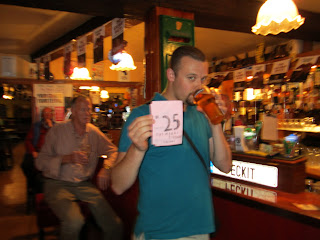
Pub Challenge 40-47

Wow, I've really let these build up, haven't I? There's even two I've yet to upload from Glasgow - I plan to visit a couple more tonight, so I can put all the Glasgow ones in their own post.

The Railway Arms, Coleraine

Fibber Magee, Belfast

Brennan's, Belfast
The Crown, Belfast.

Brilliant atmosphere in this pub. Complete with colourful
tiling, hand-carved wooden pillars, still working gas lamps
and stock drunk old guy.

Lavery's, Belfast.


Monday, 8 August 2011

Belfast

My final stop before heading off to Scotland is Belfast. Obviously this city, moreso than any other in Northern Ireland, even Derry, is famous for its turbulent past, even quite recently.
The city centre is quite cosmopolitan, and walking around it you could imagine yourself being in just about any major city in the world. It's going further out into the suburbs that the troubles become more evident. I took a guided taxi tour of these areas - the tour was fantastic, being driven around in the classic black London-style cab, and the guide/driver was very knowledgeable.
Mural in the Protestant part of Belfast
Now, the East of Belfast is the protestant area, and the west is the catholic area. Protestants, if you'll remember, are the loyalists, keen to stay part of the UK, while the catholics tend to be the Nationalists, thinking of themselves more as Irish than English. The two sides, obviously, hate each other. In more recent years it has calmed down somewhat, but during the late sixties and early seventies, inspired by civil rights movements in the US and elsewhere, the unrest was the worst. In short, the place was a war zone. For two years public transport was cancelled because buses were regularly set on fire and used as barricades. Something like one in seven police officers were killed on duty. Hundreds of bombs went off during the troubles. What is most disturbing, however, is in the protestant area. Like Derry these people are fond of their murals. However, many of them depict "freedom fighters" - heroes of the UDA and UVF (the protestant answer to the IRA), famed often for the number of people they have killed.
Belfast is truly a city divided. In 1989, when the Berlin Wall came down, we believed that would be the last we'd see of that kind of segregation of a city. But Belfast has a number of such walls itself, to keep the two communities from killing each other. The first one was built in the 70s, and was intended to be up for only a few months. It is, of course, still standing. The last one was built as late as 2008. The houses near the walls even have metal cages around their backs that stand to the walls because of things like rocks and bricks that are often thrown over. Apparently 70% of people living in one side have never had a meaningful conversation with anyone living on the other side. Most people would not have ever even gone into their "opposing" territory. There are even heavy metal gates in the walls that are closed and locked after a certain time at night.

Sunday, 7 August 2011

My experiences with the "TwentySix!" hostel.

Normally I don't take much notice of my accommodation. I mentioned my hostel in Doolin because of the ... interesting advice given to me by the owner. Typically I use a hostel for sleep and that's it. If if fulfills its pupose I'm happy and I forget it.
TwentySix, in Coleraine, was different.
Charitably I would say that the running of the hostel is laissez-faire. Less charitably, but more accurately, I would call it a shambles.
I arrived at the hostel at some time in the early afternoon. Like many small independent hostels it's just a re-purposed, unobtrusive house in an ordinary street. Upon entering I noticed three things - firstly that it was quite modern and nice, but secondly there was no sign of an office or check-in. And thirdly, for that matter, there was no sign of any staff. Wandering around I found a note on the dinner table. This form of communication would become quite familiar. The note said to call the number indicated any time of night or day if I needed anything. I dialed it and couldn't get through. I realized that this was probably because I was using a SIM from the republic of Ireland to call a Northern Irish number. So I needed to add the UK dialing code, which I didn't know. Luckily there was a computer right next to me, turned on and connected to the internet. Bear in mind I had just come in off the street and there was nobody present in the whole hostel. So I googled the number I needed and called it. After about one ring I was greeted by a rambling voice with a thick Northern Irish accent. Somewhere in there I thought I heard the word "hostel", which was the only way I was confident I had called the right number.
"Uuuhhh... I'm at the hostel and want to check in."
"Ooohh! Yeah! Sure sure, great. Sorry I'm not there - I was out on the piss last night. What's your name?"
Filled with confidence I told him who I was.
"Okay, your room's not ready yet, but you can just leave your stuff in the kitchen and I'll be there to do your room in half an hour. You're in room 5."
Okay, I guess I could live with that. I keep all my important belongings on my person at all times so I didn't have too much issue with leaving my backpack there. I headed out the door on my way to the Giant's Causeway. Two steps down the street my phone rings.
"Hi, Bjorn? It's James again." apparently that was his name "I just remembered you're actually in room 3, and that should be ready. The key's just hanging above the fridge."
I head back inside and sure enough the key was just dangling on the wall above the small bar fridge in the kitchen, where any old bozo could walk in and grab it. I grab it and tramp up the stairs to find room 3 was definitely not ready. I drop my stuff off anyway and leave another note beside James' letting him know. I also leave the key, not particularly confident he has a master key, or perhaps that it's inexplicably at his grandmother's house in Trallee or something.
So then I went off to visit the Causeway and Bushmills. I return to find, again, no James present. There is another note on the table, however, informing my that my room's ready and a receipt, hand-written on a sheet from a notepad, for the balance which I had yet to pay. So I spend a bit of time getting settled, making dinner and writing my post about the Causeway and Bushmills, and just as I'm heading out the door to find another pub for my challenge the elusive James arrives, full of beans and more than a little bit scattered. After paying him for my stay we have an energetic conversation about his plans to yet again hit the turps tonight and telling me which bars to go to and which to avoid. We then part ways again. Later on that evening, after returning from just a short escapade, I decided to sit down and watch a DVD. Half-way through my phone rings. A very drunken Irish voice is on the other end, and it takes me about a minute to realize it's James (I've received a few wrong numbers on this SIM). He doesn't know who he has called, but he's vaguely aware that it's someone staying at the hostel. He's totally paranoid that he's forgotten to lock the doors. He had already told me in great length earlier that I have to make sure the doors are all locked by 11 o'clock. At this stage it's only about 10:30. Still, he makes me go to them all to check that they are indeed locked. They are. Very relieved he thanks me heartily and the phone conversation ends. I'm not surprised not to see him at breakfast the next morning.

Saturday, 6 August 2011

Coleraine - the Giant's Causeway and Bushmill's distillery

My second-last destination here in Ireland before I head off to Scotland is Coleraine. Another, in itself, unremarkable town that just makes for a good base to see other things. The "other things" that interested me were the Giant's Causeway and the Bushmill's distillery. They both lie on the same tourist bus-route, so I was able to knock them both over not long after I arrived in the town.
First I headed off to the Giant's Causeway, and it seemed my miraculous luck with the weather finally ran out. I've gone out a number of times without my jumper or any kind of rain protection, and even when the weather's looked threatening I've managed to get away without getting wet. This time is bucketed down. Yet I was determined to see the causeway, it being one of the must-see destinations in Ireland, so I bravely stepped out of the bus and ran for shelter in the visitor's centre. And I have to tell you, though I'm not proud if it, I spent one pound and fifty pence on one of those ridiculous plastic rain ponchos. And I walked about a hundred metres with it and the damn rain stopped. Of course.
But the Causeway was good. Despite the large amount of tourists the causeway itself wasn't too built up and commercial and touristy, which I naturally appreciated. The causeway is accessed just by a muddy path (which after traversing I finally decided it should be time to buy a second pair of trousers).
The Giant's Causeway itself is an expanse of basalt stone formations on the coast leading into the sea. What's remarkable it is that the basalt is made up of thousands of (mostly) perfectly hexagonal columns, about half a metre wide. The cliffs surrounding the causeway are also made largely of these columns, and it makes for some truly remarkable landscapes. The basalt would have been laid down around 50 to 60 million years ago in a volcanic eruption. As molten rock cools it naturally shrinks, and cracks form throughout resulting in the unusually man-made-looking shapes. The reason why it typically forms neat hexagons and other polygons I don't really know, but I'm sure the answer is a quite esoteric and complicated one, so just enjoy the pretty pictures.

Bushmill's Distillery
On the way back I stopped at the Bushmill's distillery. I did it second because I thought it would be a good idea to do the indoors tourist attraction after the rain had stopped, so I could get soaking wet outdoors beforehand. Bushmill's distillery is the oldest licensed distillery in the world, having been opened in 1608. As such I expected the tour to be much more historic than the Jameson's one. I found that it was quite the opposite. Whereas the original Jameson's distillery, where the tours operate, is no longer used for distilling, the Bushmill's distillery is still actively used. The whole tour was dominated by huge stainless steel containers and industrial looking equipment in concrete buildings. Still fascinating, and for 7 pounds with a free glass of 12 year old single malt at the end I wasn't complaining.

Pub Challenge 34-39

The Strand Bar, Derry

The Derby Bar, Derry

Tracy's Bar, Derry

Peadar O'Donnell's, Derry

Gweedore Bar, Derry

Bushmill's Distillery, Bushmill

Friday, 5 August 2011

Derry, second day

First off I want to share with you something that I did yesterday. This is the kind of spontaneous occurences that I love while traveling. I was looking for a new towel, mine having fallen off my backpack where it was hanging to dry out and disappeared, when I came across the local theatre. Last night just happened to be the opening night for a local production to Sweeney Todd, which just happens to be my favourite musical. Shame they never made a movie version. Nope. None exists. At all. I'm sure of it. So I bought a ticket, and for 7 pound 50 I think it was a good price too. And it was a pretty good adaptation by all standards, though considering the most recent one I saw to compare it to was the (non-existant) Tim Burton version, I may have been quite charitable. Anyway, this is a travel blog not a theatrical review blog, so I'll spare the 10 page analysis I could have otherwise given. But I will say that the actor playingg Pirelli was the first I've seen that's been able to pull off both the required Italian and Irish accents, though presumably the Irish one wasn't such a stretch...
City Walls

So today I saw the other side of Londonderry's history. I use the name Londonderry this time because, as you may have guessed, I did a tour and visited a museum covering the Loyalist/Protestant side of the story. Again, let me stress that at its core the conflicts in Ireland have never been about religion - they have been about politics and class. And while it may have sounded in my last post like the protestants all sat in their ivory towers wearing monacles and smoking pipes while throwing stones on the impoverished Catholics, this is also far from the truth. The local protestants had their share of troubles as well, particularly in 1688. At the time the Catholic William of Orange was contesting for the British crown against King James II. Londonderry was an important strategic point at the time, but was naturally held by protestant loyalists. William laid siege to the town for over 100 days - still the longest siege in English history. And not a nice one as the inhabitants of the city died in great numbers of disease and hunger, and foul meat from horses, rats and even dogs was the order of the day. Finally, however, the siege was lifted by the arrival of friendly ships bringing food and arms.
So the walls are incredibly important and iconic to the minority protestant portion of the city. Even though the politics were heavily weighted to suppress catholics and promote protestants, the protestants were still a minority. Particularly with the IRA's attacks in the 70s many protestants were driven from their home in Londonderry. It's clear at this time nobody was having a good time.

Derry, first day

Derry (also known as Londonderry, usually by Loyalists) is a beautiful city. Enniskillen had started to give me the impression that all of Northern Ireland was going to be bleak and ... kinda soviet. This city is far from that. Derry, almost as much as any city I've ever been to, has a really strong sense and pride of identity and character. It's main feature are the massive City Walls, built in the early seventeenth century by the British, which are an example of some of the most intact ancient stone walls of any city in Europe. They still very much enclose the city centre, which gives the whole city a very unique feeling.
The building of the walled inner city was of course a signature point for the conflicts between the British and the Irish. Visiting the "Free Derry Museum", I learned a lot about the city's turbulent past. A key place in the city is the so-called "bogside" - early in the city's history this part was very swampy, earning its name. Of course when the British asserted their presence here and built the walled city they took the nice, firm, solid ground and the local Irish had to live in the Bogside. And throughout the city's history this attitude would set a trend, and the city would be central and iconic for the Irish people's struggles agains British rule.
One of the many murals in the Bogside,
this one displaying a scene from Bloody Sunday
You'll often hear that the conflicts in Ireland have to do with religion - Protestant versus Catholic. Seriously, the respective religions are so similar and private enough - do you really expect people to kill each other over them? No, it's political. The British brought protestantism to Ireland, and the locals were Catholic. It was a class and allegiance struggle, where religion was just a simple way to differentiate what side you were on. Also later it was easy for the Crown to target religion as the reason for the fighting to make themselves not look bad.
I had a tour guide that lived through some of the worst parts of this crisis. Perhaps you can tell that from the last paragraph.
He was the kind of tourguide you always want to have - not just someone familiar with the material, but someone who has first-hand experience. He even personally saw a neighbourhood 11 year old boy killed by the English military. So yeah, this post may sound a bit biased. So sue me.
Basically, the conditions for the Catholics (and by that I mean the original inhabitants) were terrible from start to finish. They were oppressed by English rule for hundreds of years in the area, but the whole thing blew up in the late 1960s and early 1970s. In the 60s there were a number of protests all around northern Ireland, one of which marched from Belfast. This protest group was attacked by various loyalists, including police. This action stirred the Bogsiders into their own action. They built barricades around the whole bogside, effectively secceding from Northern Ireland (keep in mind this area is only half a city in size). Naturally the British didn't like this, and for the next few years fighting and complicated politics happened regarding this. It was during this time that the iconic slogan "you are now entering Free Derry" was painted on a gable on the street leading into the bogside.
This all culminated into the so called "bloody Sunday". Protests by Irish Nationalists and Unionists (not exactly friends, though with the same goal. It's complicated) reached boiling point when the British declared that Irish nationalists could be detained without trial. Similar rules exist now with Guantanamo bay. There were protests almost daily, and finally the Crown sent a paratrooper regiment into Free Derry. They fired on a group of innocent civilians, killing 13 and seriously wounding another 15. The museum, I might add, was quite graphic regarding this - they had several articles of clothing from those killed, complete with bullet holes, and even a giant banner covered in blood where someone was shot in the head.
So slowly after this there was some reform. After a lot of political machinations the IRA decided that politics rather than violence is the way to go. Now it seems like Northern Ireland has settled into a comparatively peaceful state, though there's still a way to go.

Thursday, 4 August 2011

Enniskillen

Enniskillen was my first stop in Northern Ireland. I have to admit, I had a lot of expectations about Northern Ireland, but I hardly noticed the difference at all when crossing the border. For example, there were relatively few bombs going off, and practically no gunfights at all. Overall, Northern Ireland is considerably more peaceful than one might expect.
However, my first real impressions of the town/city lfe here was strangely familiar. Enniskillen at least had a slight air of East Germany about it. It's just a bit greyer, and a bit more aware of its turbulent past.
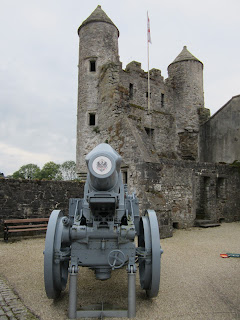
Inside the grounds of Enniskillen Castle
The first thing I did here was visit the obligatory museum. It was quite nice, though a bit bizarre to my mind. It's located in the old castle of the city, and as such the exhibitions have to be seperated into two seperate buildings for reasons of space. The first one began with a rather mundane display of old clothing from the last hundred years or two which inexplicably passed directly into a diorama-filled section about biology and prehistory of northern ireland. After barreling through several tens of thousands of years of history the first part of this expo ended with life in the late 19th century. Now, the castle obviously has been used for military purposes quite recently, so the whole rest of the museum is strongly military in nature - giving information on the various wars Ireland has been involved in. It was all quite nice, but more something I'd expect in a museum in the US.

After the Museum I went on a tour of Lough Erne, which was quite a different experience. For one thing it took place mostly on a boat rather than in a castle.
Lough Erne is the predominant lough around Enniskillen, and the most important island nearby is Devenish island. It has a number of ruined buildings on it, mostly religious by nature. Remember how I said monks used to love punishing themselves needlessly by building churches and abbeys in hard-to-access and generally unfriendly places? This was another example. And for years it was used for local people to go to church. By boat. Then, after one boat sank and downed 19 people, the local people thought that maybe a church closer to town would be a better idea. After that the churces on the island fell into ruin.
The Round Tower on Devenish as seen
through the ruins of the church, thereby
reducing the number of photos of
monuments I have to upload.
The only other building of note on the island is the impressive round tower, which was naturally used by defense. Of course the stupid thing has been closed due to an accident which involved the staircases collapsing inside for about three years, adding yet another item to the list of things I could have climbed but didn't.

Pub Challenge 32 and 33

Gerarghty's, Westport


Horseshoe and Saddle, Ennikillen

What's the big fuss about Matt Molloy's anyway? (Pub Challenge 29 - 31)

So, you might have noticed a couple of posts ago my making a huge fuss about a certain Matt Molloy's Pub in Westport. Matt Molloy is a member of the seminal Irish folk band the Chieftains, who pretty much created modern Irish folk as we know it today. His Pub, then, is a pretty legendary place in Irish Celtic music. Some people come to Westport for a pilgimage to Croagh Patrick, I came to Westport for a pilgrimage to a Pub.
Live Music hadn't started at Matt Molloy's yet, so I went to
J. Ging's to wet my whistle
The Clock Tavern
Matt Molloy's
To tell you the truth, I was a bit disappointed. It was way too crowded for one thing. A lot of American tourists with an Irish great-great-grandmother, obviously, heard that this place was somehow an important destination for Irish music lovers. (Imagine the most infuriatingly condescending Americn accent saying "oh, real Irish music? How cuuute!)
There was live music in the tiny, crowded back room. But surrounded by a bunch of yanks who didn't really appreciate it anyway yelling "yee-haa!" as if this was some country barn dance in the deep south. I wish I were making this up. I even saw a couple of those ridiculously oversized cowboy hats texans seemingly love wearing. I might have to come back here in the winter when it's not so crowded...

Now, again this computer has decided it's going to be difficult about photos. I'm going to try to post the next 2 pubs in a seperate post.


Tuesday, 2 August 2011

Westport

First off, I want to apologize that this post is a bit light on pictures. I did take plenty, but the computer I'm using is again my enemy. This time it's just an old, belligerent, inneficient XP machine that hates photos.

Croagh Patrick
Today I headed north to a town called Westport. It's a beautiful little spot that reminds me a bit of Kilkenny, but with a bit more of a continental European flair. And if that doesn't make me sound like a toff, I don't know what will.
Like Galway, there's not a whole lot in the way of tourist attractions in the town itself. There's really only Westport house - a kind of adventure park mainly for kids. Other than that it's a good base for going to Croagh Patrick, a nearby mountain and pilgrimage destination for catholics. It was this peak that St. Patrick supposedly climbed in 441 AD, fasted for forty days, built a church and banished all the snakes from Ireland on its summit. It dominates the landscape in this area, although it's a fairly standard, almost stereotypical, triangular mountain shape. For aesthetics I give it a mere 6/10. With a lot of training perhaps it can come back in 4 years time and try again for the gold.
So, if there's not much to do here, why did I come to Westport, I hear you ask? Well, for one thing it was the biggest, most interesting town between Galway and Enniskillen, my next stop. Secondly it's home to Matt Molloy's Pub, but more of that in the next post.
Firstly, what I did:

Upon arrival the weather was reasonably nice. And by that I mean it wasn't raining. I quickly found the hostel - Abbeywood - which is an old estate house. You know that smell you get in old houses that have been turned into museums? That's what this place smells like. Don't get me wrong though - it's a nice hostel. My room even has a rocking chair in it.

So after I had dropped off my stuff I went into town to get some supplies, getting a nice look at the town in the process. There's a pleasant little river that winds through and around the town with a series of little stone bridges spanning it. Peeking over one of them and through the trees on the other side I even saw a young couple smooching. The whole town had the feeling of a romantic medieval village. Upon return to the hostel the weather was starting to look less and less promising. Seeing as a pattern is clearly developing, I realised there was nothing else for it - I went for a long walk without my jumper.
The lady at the hostel had given me some directions for a nice walk around the town. Unlike those given by Karl at Doolin, these directions didn't sound the least bit suss. This should have worried me. But in lieu of anything better to do, I took them anyway. Now, there's two paths that lead around Westport - one on either side of the town. I was to take the first one along the river which passes by Westport House. It comes out somewhere near the railway path which follows some old train tracks back on the other side. Setting off, it wasn't long before I came upon a sign saying "river walk". Everything was going to plan. The sign pointed down a little road rather than a path, but who was I to argue? Before long, though, I was led into the seedy back carpark of the Westport Hotel without any clear exits. Slightly confused I had a bit of a look around. Eventually I spotted two exits - one bridge leading who-knows-where and a little path leading along the river, but somewhat higher and removed from the edge of it. This one was the obvious choice so I went down it. But a little way along I became suspicious I was going the wrong way - I should be following the flow of the stream. I stopped and tried to peep through the trees at the river to see which way it was flowing. And then I realized I was staring directly at the two lovers again. They spotted me staring and I hastily strode off, hoping they didn't think I was a lurker. Eventually the path met a smaller path coming from the same direction but closer to the river. As it looked more like a 'river walk', I decided that it must be the one I want. Of course a few metres down this I came upon Romeo and Juliet again. I marched past them as if on a mission, trying not to look while they got up, looking a little bit embarassed and annoyed, to look for another romantic spot where they wouldn't be disturbed.
The path, however led me back to the seedy carpark. Okay, this time I tried the bridge. On the far side of it I already saw a sign saying something about Westport House. Ah - this looked like the right path finally! But once I got there I found the far side of the bridge heavily gated and barred. There was absolutely no passage here, and it didn't look like it had been open for quite some time. The sign for Westport House had a big red arrow pointing to the right. There was absolutely no way off the bridge to the right without jumping in the river. After long deliberation I decided against this option, and opted instead to go the other way around, taking the train-track path and hopefully meeting up with the other end of the river path.
I followed the river upstream again, as that was the best way to get to the other side of town and the start of the railway path. I passed Romeo and Juliet again, hiding my face with a tree branch. I then proceeded to pass by the rather obvious entrance to the railway path before retracing my steps and finally embarking on it.
It was a bit dull, feeling a lot like every well paved walking track too close to a town or city. There was little in the way of a view or character - just an asphalt path and green slopes on either side. Occasionally Croagh Patrick would peek through on the left. But eventually I ended up on the road that would lead me back onto the river path.

The nice part of the walk
This was probably the nicest part of the walk - the short stretch of road after the railway path and before the river path. Passing by Westport Quay and some stinky but pretty mudflats and wetlands. Pretty soon, however, I was back on a bland path to Westport House. There was a lot of archery, mini-golf, go-karts, and that sort of thing going on everywhere. I also found that the last tour of the actual House, another old manor house, finished about an hour ago. It would have been the only thing I would have enjoyed doing there, seeing as I'm no longer 12 years old. So I followed the river path, just as bland as the railway path, back to Westport, desperately curious as to where it actually came out. It came out in a seedy back carpark of Wesport Hotel.

Anyway, I'm off to Matt Molloy's Pub. Update in a few hours if I'm not too drunk. If I am, expect one tomorrow.


Pub Challange 27 and 28

Fox's Porterhouse, Galway
Interesting anecdote: I am drinking a pint of
'Galway Hooker', a Pale Ale, in this picture.

An Púcán, Galway

Monday, 1 August 2011

Pubs number 23 - 26

Richardson's, Galway
The King's head, Galway
The Merry Fiddler, Galway
Tigh Joe Mac, Inishmore

Galway and Inishmore

Galway is a very nice city. There isn't heaps in the way of tourist attractions in the city itself, but it makes a great hub to travel from, and it's nice to just walk around it. As such I spent yesterday after I arrived walking around, visiting a few more pubs, and today I took a tour to the nearby Aran Islands, specifically Inis Mór (or Inishmore) the largest of the three.
I mentioned in my Cliffs of Moher post how I was the only idiot wearing short sleeves. Today, again, I left my jumper in the Hostel. Seriously, what is wrong with me? This is Ireland! I do it like I have something to prove. What, or to whom remains a mystery. Upon arrival at the port for the ferry I saw threatening dark clouds all around me and cursed myself. In this case I happened to have been lucky - the weather fined up magnificently later on. This was also my first ferry of my Europe trip, and I have quite a few left to go. I just hope they're not all as crouded as this one, because most of them will take considerably longer than the 45 minutes it took to get to Inis Mór.
This is how the whole of Inishmore would have looked
before human settlement.
The island is similar in makeup to the burren - it's completely karst, so the broken limestone is abundant. My options for exploring it upon arrival were guided bus tour for €10, or bike hire for the same price. As the weather had not yet shown any promise and I am terminally lazy, guess which one I picked?
The bus seats were cramped. I mean cramped. Luckily I had nobody sitting next to me, because the only way I could sit is sideways. But the tour guide was funny and informative, so it was a good tour.
The first thing that struck me was his accent. Inis Mór is one of the few places left that still speaks Irish Gaelic regularly. The island only got electricity (and hence television) in the 1970s, and before that almost nobody spoke English, so Gaelic is still predominant. The guide, whilst understandable, had a very different accent, though still clearly Irish, than I had heard so far. It's hard to explain,  but it did sound like the accent of someone who usually speaks another language.
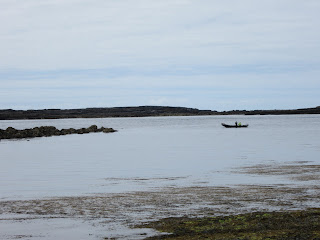
The fisherman and his son
The island only has a population of about 900 or so, but as it was one of the few places in Ireland that the potato blight barely effected, during and after the famine it had as many as 3000 people, then dropping again after a Tuberculosis epidemic. Now the number one industry, with tourism only coming second, is fishing. I saw one fisherman and his son at work, and I had to admire them. These were real fishermen, using the style of boat that has been typical here for over a hundred years and only minimal equipment. The tourguide spoke with the father in Gaelic, but the fisherman was only able to speak a few broken words of English to the tourists. Funny how an island, once the place to be in Ireland, is now one of the most remote and untouched. However, compared to how it was before human settlement it's practically a metropolis.
The landscape is as such barren. The perforated limestone is like a sieve for water and practically nothing can grow there. And yet, wherever there's a hellish speck of land that only wants to kill you, there's some loony who wants to live there. So people managed to somehow make it farmable. They did so by,  first of all, clearing the ground of loose rocks and building low walls for small paddocks. Then they hauled massive amounts of sand and seaweed from the shore to fill in the fields. Then they planted potatoes, because they apparently put up with anything, and after one season they do a pretty good job of turning that muck into workable soil. It seems to have worked too, because there's a lot of green here.

The main feature of the island is definitely the fort Dun Aengus. The first fortress was built on the edge of the frighteningly high and steep cliffs in pre-celtic times, about 2500 years ago at least. As fortresses usually are, it was repurposed a number of times by the different people who have lived there. Now it's just a ruin. But for views that'll make you want to lie down until the world stops spinning, it's second to none. The cliffs are nearly 100 metres high, and there is no guardrail or anything. Surprisingly no tourists have gone over in over 10 years.
Also interesting were the Seven Churches. Just what they sound like - it's a complex of ruined places of worship with a tumbling graveyard all round. Through a mixture of being as far from invading Vikings as possible and a need to prove their faith almost to the point of masochism, Monks of the medieval period loved building churches and monasaries in the most unlivable and nasty places in the british isles. Hence seven churches. Then Oliver Cromwell came along and spoiled all their fun, but that's another story.

Sunday, 31 July 2011

Doolin, second half of the day.

After my hasty picture-less post about the cave yesterday, I went on to see the cliffs of Moher, which are an absolute must when you're in the area. I asked the guy running the Hostel what the best way to see them was. Now, there's an official visitor's centre for the cliffs which, naturally, is very touristy. If you haven't noticed yet, I'm not a big fan of overly touristy things. So Karl, the hostel guy, said I shouldn't bother with it and there's a way to see the cliffs without paying for it anyway. He then proceeded to explain a detailed and very sketchy-sounding route that would involve jumping a gate, walking dangerously close to the cliffs (jumping the fence into the next-door paddock when the path got too close) and generally wandering off into almost certain death or prosecution. Skeptical, I decided to at least go as far as the beginning of the path. One look down it and I thought better of the idea. Subsequently I realised I maybe should have risked it, but I'll get to that later.
So then I headed off to Gus O'Connor's, which was right round the corner, for a quick bite to eat. As luck would have it, a session was currently in progress in the pub with three musicians. One of them was even playing the uillean pipes, which I had the pleasure of hearing live for the first time. Good thing, then, I thought, that I didn't decide to risk my life and try to see the cliffs down that little goat-path.
Instead I decided to take a bus to the cliffs. Upon arrival I discovered the cliffs were free to see anyway. However, the visitor's centre is tacky and touristy, and as for the cliffs themselves - well, they're cliffs. They're mighty impressive, but there's not a lot to say about them. That's why I've included pretty pictures! I would have liked to wander a bit further up and down the cliffs - there was a decent path to follow for quite a while - but the weather had decided to take a dislike to all the tourists and was blustering and spitting and being generally untoward. And of course I was the only chump there with short sleeves. They were selling rain ponchos at the centre, but there's no way I was paying €2.50 for what amounts to a garbage bag with holes in it.

After the cliffs I went back to McGann's Pub. A friend I had made in Cork, Lauren, was going there to drink away the cold, and I had nothing else planned so far so I decided to join her. Whilst sitting there, throwing back pints of Guinness, I realised there was one more thing I wanted to do in Doolin, and that was to see the Burren. Burren in Gaelic means rocky place. Basically the whole area is Karst, which means the ground is all limestone, hence all the caves. It also makes for truly spectacular and unique scenery. A few miles out from Doolin there's the Burren National Park, but it's much too far for walking to be an option, and techinigally the whole area is part of the Burren, not just the park. The few pints of Guinness I had had made me feel invincible by this stage, so I bravely marched back to my hostel and demanded Karl give me directions to a good place to see the Burren. These directions sounded even more sketchy than the Cliffs of Moher directions - I was to follow the tiny road next to the Hostel out toward the sea. When I get to a gate that looks like its the end of the road with a sign saying "beware of Bull" I was to simply pass by to the right of it. A tumbling dirt track would then lead me to two iron gates. I was to hop over the first one and cut across the fields until I reached the sea. I could then follow that around and get as much of the Burren as I pleased. The Alcohol still coursing through my veins still gave me courage and I strode off. And let me tell you, it was one of the best experiences of my life.
Before I even got the the "Beware of Bull" sign I noticed the landscape around me becoming very dramatic and somehow alien. After jumping the iron gate and walking for a couple of minutes it became truly stunning. I didn't have to worry about anything too touristy - the only traces of civilisation I could see after a while were the waist-height stone walls probably built 200 years ago. Like the cliffs, pictures serve here better than words. But bear in mind that like caves, pictures will never truly do justice to the feeling of actually being there.
Karl had told me it would take me about half an hour to walk, but I'd probably take longer as I would want to take it all in. At first I didn't believe him, but a believer was made of me when I returned an hour and a half later. Then all that was left was to return to McGann's pub and wax lyrical to Lauren about how awesome it truly was. Her reaction was exactly the same as my initial reaction to Karl's directions.


Pub Challenge, No.s 17-22

At last, the long-awaited update. Finally a chance to access the internet from a decent computer!
Well,  okay - the keyboard is worn out. And I mean REALLY worn out, and the OS seems to have developed some cantankerous quibbles, but at least I can upload some pictures!

Eviston House, Killarney

The Stretford End, Killarney
Mc Dermott's Inn, Doolin
McGann's Pub, Doolin
FitzPatrick's Bar, Doolin

  
Gus O'Connor's, Doolin
You'll notice the last 4 pubs were all in Doolin. Doolin only has 4 pubs, and I did them all in the same night. For some reason I'm very proud of that fact.