So that's what I get for being prepared. Worried that I wouldn't catch my ferry to Cyprus today I went to a lot of effort over a week ago to rearrange my trip, cancelling a night in Ankara, driving all the way through to Göreme a day early, changing the booking there as well, booking a room in Taşucu where the ferry leaves from, trying to call a couple of days in advance to confirm the ferry and making a sacrifice of a choenix of wheat (look it up) and a small goat to Poseidon. And this morning when I went to check in (half an hour early) I discover it isn't running due to bad weather. And my day didn't get much better. In fact my bad luck didn't even start there - I woke up with a little bit of a stomach bug. Nothing bad enough to put me out of commission, but let's just say I felt ... uncomfortable the whole day. And it's been horribly muggy which did't help.
After some time in the local internet café working out my options - do I wait for the ferry tomorrow, do I travel all the way back to Istanbul and try to catch the 9:30 plane to Cyprus from there, do I say bugger it and catch a plane back to Germany, do I head back to Göreme and see what I missed - I eventually decided on the first option, cutting my already short visit to the island even shorter. Ideally I wanted about a week there, but due to the irregular reasonably priced flights back to Germany I originally shortened it to four days. Now the ferry has made it a pitiful three. So, trying to make the most of it, I headed today to the nearby town of Silifke to see if there was anything worth seeing or doing. At the tourist office I was handed a xeroxed copy of a map that looked like it was made in MS Paint. However it did promise some interesting sounding sights in the "ancient city" area as well as an archaeological museum. I headed off to the museum to find my disappointments were only just beginning - the place was closed. Apart from that I can only assume that the map that I thought was in English was actually in Turkish, and that things like Theatre, Necropolis, Mosaic and Water Cistern actually meant nuanced variations on "Slum" and "Ghetto", and that "Ancient City" simply meant "don't go here after dark". The only thing that I was in any way capable of finding in the spot where it was supposed to be was the Roman Temple and, well, I'll let the picture of that speak for itself. Except this computer won't accept my camera. Today just keeps getting better.
Showing posts with label Turkey. Show all posts
Showing posts with label Turkey. Show all posts
Monday, 10 October 2011

Sunday, 9 October 2011
Cappadocia
 |
| Part of the open air museum |
 |
| Inside a church I was "allowed" to photograph |
 |
| Çavuşin complex |
 |
| Some fairy chimneys |
And, well, it was a balloon ride. Spectacular. But I have to let the pictures do the talking.
All said and done, I think I could have spent a lot more time in Cappadocia. I only saw a fraction off all the valleys, fairy chimneys and rock-cut settlements in the area.


Thursday, 6 October 2011
Istanbul day 2
 |
| Aya Sofia |
Another jam packed day in Istanbul! It began with getting up late. Well, 8:30, but that's late for me at the moment. I then headed back to the main historical area in Istanbul to visit Aya Sofia. Now this is a building with some history. It was originally built in the fifth century by the Byzantines as a church on the site of an older one which had burnt down in the year 404. I'm told that the first occurence of the "404 error" was when someone showed up the next day and couldn't find the church. The new one, which is pretty much the same building that's standing there now, was Constantinople's primary cathedral until about 1453 and it's conversion into a mosque. And I have to admit, I'm impressed with the Sultan's conscientiousness. In Islam images of people and animals are not allowed in mosques, but instead of simply tearing down all the beautiful mosaics they were carefully documented and copied onto paper then plastered over. And as impressed with the liberal thinking of the Sultan as I may be, Ataturk takes the cake. When he came to power of the new republic in the 1920s he immediately set about secularizing Turkey and bringing it into the 20th century. Two of his actions were to convert this immensely important mosque and the Sultan's palace into a museum, uncovering again all the mosaics from Byzantine times.
 |
| Interior of Aya Sofia |
 |
| Sultans' tomb |
 |
| Inside the palace |
 |
| Çemberlitaş |
 |
| Aquaduct |
 |
| Spice Bazaar |
Istanbul day 1 photos
As promised, pretty pictures!
 |
| Some ancient Mesopotamian art |
 |
| Basilica Cistern |
 |
| The Blue Mosque |
 |
| The Blue Mosque from the inside |
 |
| Galata tower |
 |
| Sunset from Galata tower |
Wednesday, 5 October 2011
Istanbul, day 1
Well, I'm certainly glad that I decided not to drive in this city. Yesterday I drove to Istanbul International Airport from Cannakale and left my car in the long term carpark there. The drive there was nasty enough, as I still had to drive through about 10 kilometres of Istanbul motorways to get there, and half of it was a big roadwork site. Turkish people are pretty Laissez-Faire when it comes to road rules at the best of times, but when there's no lines on a technically three lane road with stop-start traffic its positively harrowing. The traffic in the city proper is worse.
Well anyway, I'm glad I don't have to think about the car for a few days. Right now I'm in one of the most vibrant, cultural cities in the world. And it's huge - with a population possibly larger than the whole of Australia and a history that spans over two thousand years, I don't think I can do it justice in the few days I'm here, but I'm giving it a shot.
Today I started off with the Istanbul Archaeological museums. Basically it's a complex of three buildings with a bewildering amount of antiquities to see. About halfway through the second one I had a brainfart and simply couldn't process any more. I knew this would happen, which is why I went to the Mesopotamian exhibit first, as I've seen precious little of Mesopotamian finds so far in any museum, and the culture intrigues me at least as much as the Minoan. The Sumerian culture of the area of course was the world's first civilization, starting off at the whopping early time of before 3000 BC. Remember how much effort I put into explaining how old the Minoans were at 1800 BC? Let that sink in.
The other thing I took from the museums was a decent understanding of the history of Turkey and Istanbul.
Lying as it does at the important position between east and west, Turkey has been invaded and ruled by more people than seems fair. The first empire that controlled the area was the Hittites, coming from the same cultural space as the Mesopotamian civilizations. These guys held onto the country until about 800 BC. After the Hittites the Persians took the reigns and generally made life difficult for the Greeks for a few hundred years. When Alexander the Great came out of Macedonia and started taking over the world of course he needed to have a go at Turkey as well. Next of course came the Romans. In the early fourth century AD the Roman empire, getting too big for its boots, was divided into the eastern province and the western, with the city of Byzantium as its capital and renamed Constantinople after the Emperor at the time, Constantine. Today this city is known as Istanbul. Not long after, this divide turned into a complete split, the eastern and western empires becoming effectively independant of each other. The western part, after a particularly nasty invasion from the Germanic tribes, fell to bits, but the eastern part, known nowadays as the Byzantine empire, chuffed along, slowly stagnating until the crusades finally put an end to their fun. It's something most people don't realize, but the existence of the Byzantine empire for all this time effectively means that Rome survived well into the second millenium AD.
So then it was the Ottoman Turks' turn to have a piece of the Turkey Pie (sounds tasty). These guys, led by fat, beardy Sultans, turned Turkey into an Islamic country, converting its many churches into Mosques. The Ottoman Empire lasted until 1923 when, after a war of independence, the Sultans were kicked out and the country became a republic under Mustafa Kemal Pasha, renamed Ataturk. This same dude led the Turkish forces in World War I against the Anzacs.
So now you know the history of Turkey as well!
After the museums I visited the so-called "Basilica Cistern". This huge underground cistern was built in the Byzantine era to supply water to the palace and was forgotten until the 16th century when a French archaeologist noticed the locals catching fish by dropping a bucket through a hole in their floor.
It's a strange, eerie kind of place - or at least it would be without the hordes of tourists and built up gangways about the place. It's filled with a forest of columns, and a population of carp even swim about in the water. Interesting to note is the two columns at the far end with carved medusa heads as their bases. Nobody really knows why they were used, where the Byzantines got them or why one is upside down and the other on its side.
After the Basilica Cistern I visited the Blue Mosque, which is one of the prettiest buildings in the city. And its then that I realized that for my whole time in Turkey this was the first time I visited a mosque.
Finally I visited the Galata tower. This building is very prominent in the skyline of Istanbul. It was built in 1348 on the site of a much older tower. At the time the district of Galata was a walled citadel, and this one of its main defenses. Throughout the years it's been damaged, burnt, repaired and repurposed a number of times, and at the moment it serves as a restaurant and bar. My constant desire to climb landmarks drove me to go up it, despite numerous advice not to bother and go the hotel next door for exactly the same views. I should have listened. I thought it would have been a gruelling stair climb for just a balcony like most of the other monuments I've climbed, but as it turned out it was an elevator to a restaurant and a narrow balcony that was so packed I couldn't even go out onto it.
Still, it was a great day. And Istanbul is... well, it's Istanbul.
Photos tomorrow.
Well anyway, I'm glad I don't have to think about the car for a few days. Right now I'm in one of the most vibrant, cultural cities in the world. And it's huge - with a population possibly larger than the whole of Australia and a history that spans over two thousand years, I don't think I can do it justice in the few days I'm here, but I'm giving it a shot.
Today I started off with the Istanbul Archaeological museums. Basically it's a complex of three buildings with a bewildering amount of antiquities to see. About halfway through the second one I had a brainfart and simply couldn't process any more. I knew this would happen, which is why I went to the Mesopotamian exhibit first, as I've seen precious little of Mesopotamian finds so far in any museum, and the culture intrigues me at least as much as the Minoan. The Sumerian culture of the area of course was the world's first civilization, starting off at the whopping early time of before 3000 BC. Remember how much effort I put into explaining how old the Minoans were at 1800 BC? Let that sink in.
The other thing I took from the museums was a decent understanding of the history of Turkey and Istanbul.
Lying as it does at the important position between east and west, Turkey has been invaded and ruled by more people than seems fair. The first empire that controlled the area was the Hittites, coming from the same cultural space as the Mesopotamian civilizations. These guys held onto the country until about 800 BC. After the Hittites the Persians took the reigns and generally made life difficult for the Greeks for a few hundred years. When Alexander the Great came out of Macedonia and started taking over the world of course he needed to have a go at Turkey as well. Next of course came the Romans. In the early fourth century AD the Roman empire, getting too big for its boots, was divided into the eastern province and the western, with the city of Byzantium as its capital and renamed Constantinople after the Emperor at the time, Constantine. Today this city is known as Istanbul. Not long after, this divide turned into a complete split, the eastern and western empires becoming effectively independant of each other. The western part, after a particularly nasty invasion from the Germanic tribes, fell to bits, but the eastern part, known nowadays as the Byzantine empire, chuffed along, slowly stagnating until the crusades finally put an end to their fun. It's something most people don't realize, but the existence of the Byzantine empire for all this time effectively means that Rome survived well into the second millenium AD.
So then it was the Ottoman Turks' turn to have a piece of the Turkey Pie (sounds tasty). These guys, led by fat, beardy Sultans, turned Turkey into an Islamic country, converting its many churches into Mosques. The Ottoman Empire lasted until 1923 when, after a war of independence, the Sultans were kicked out and the country became a republic under Mustafa Kemal Pasha, renamed Ataturk. This same dude led the Turkish forces in World War I against the Anzacs.
So now you know the history of Turkey as well!
After the museums I visited the so-called "Basilica Cistern". This huge underground cistern was built in the Byzantine era to supply water to the palace and was forgotten until the 16th century when a French archaeologist noticed the locals catching fish by dropping a bucket through a hole in their floor.
It's a strange, eerie kind of place - or at least it would be without the hordes of tourists and built up gangways about the place. It's filled with a forest of columns, and a population of carp even swim about in the water. Interesting to note is the two columns at the far end with carved medusa heads as their bases. Nobody really knows why they were used, where the Byzantines got them or why one is upside down and the other on its side.
After the Basilica Cistern I visited the Blue Mosque, which is one of the prettiest buildings in the city. And its then that I realized that for my whole time in Turkey this was the first time I visited a mosque.
Finally I visited the Galata tower. This building is very prominent in the skyline of Istanbul. It was built in 1348 on the site of a much older tower. At the time the district of Galata was a walled citadel, and this one of its main defenses. Throughout the years it's been damaged, burnt, repaired and repurposed a number of times, and at the moment it serves as a restaurant and bar. My constant desire to climb landmarks drove me to go up it, despite numerous advice not to bother and go the hotel next door for exactly the same views. I should have listened. I thought it would have been a gruelling stair climb for just a balcony like most of the other monuments I've climbed, but as it turned out it was an elevator to a restaurant and a narrow balcony that was so packed I couldn't even go out onto it.
Still, it was a great day. And Istanbul is... well, it's Istanbul.
Photos tomorrow.
Monday, 3 October 2011
Gallipoli
 |
| Anzac Cove |
 |
| Lone Pine Cemetary |
A short time after landing on the beach the campaign hit a stalemate with both sides dug into trenches, not budging. About 9 months later, realizing it was futile to continue, the ANZACs pulled out.
 |
| What's left of one of the trenches |
All up there were about a quarter of a million soldiers killed and twice as many wounded in this campaign. Even so it's often referred to as the last 'gentleman's war' - throughout the course of the campaign there were numerous cease-fires called in whice both sides would do things such as help each other collect their dead or, as during Christmas, even have a football match in nomans land. Even while there was fighting, each side would throw into each others' trenches presents and exchanges such as tobacco and rations. And then they would shoot at each other.
Sunday, 2 October 2011
Troy
 |
| One of the main entrances to Troy in one of the earlier building stages |
 |
| Different layers in Troy's history |
 |
| Walls of Troy. I think these might have dated from the Trojan War period, but don't quote me... |
Still, the place is fascinating.
Pergamom
 |
| Yet another damn Zeus temple, Pergamom |
 |
| The view from the Pergamom Acropolis |
 |
| Ancient road to the Asclepeion |
 |
| Grounds of the Asclepeion |
Friday, 30 September 2011
More cities of the Ionian league (and Magnesia)
 |
| Athena temple at Priene |
Today I visited three sites - Priene, Miletus and Magnesia. I'll try to keep this one short. Priene and Miletus were both cities in the Ionian league I mentioned in the last post. Magnesia, despite being very much in the same area, was not accepted into the league. This was basically because it was settled by the "wrong kind of people".
 |
| Miletus |
 |
| Magnesia |
Ephesus
After Pammukale ıt was off to Sleçuk to visit Ephesus and the Artemis temple.
Ephesus was in it's heyday one of the most important cities in the Mediterranean. In fact, in the first century BC it was, with 250,000 inhabitants, the second largest city in the world. Basically you can split Ephesus' history into ancient Greek, Roman, Byzantine and Turkish. During the Ancient Greek era it was part of what was known as the Ionian league, similar to the Lycian league. Again all the cities in the league were in what is now Turkey, but located along the Aegean coast, in an area then known as Anatolia. In the first century BC it came under Roman rule, and continued on more or less how it was, but obviously with a lot of Roman influence. Then with the split of the Roman empire, the Eastern half, the Byzantine empire, took it over. By the time the Turkish empire took over, it was just a little town, having been devastated by a series of natural disasters. Eventually in the 15th century it was completely abandoned.
Just outside the city was also the famous Temple of Artemis - another of the 7 wonders of the ancient world. This really suffered in its time, being subject to earthquakes, fire and wholesale vandalism. As you might guess, the site looks a lot like that of the Mausoleum of Halicarnassus. Worse still, the moment you walk into the site, a horde of peddlars come out of the ground and from the sky and try to sell you guidebooks and useless junk. Still, now I've been to 4 of the 7 sites. That's over half!
 |
| Gate of Augustus, Ephesus |
 |
| The restored Facade of the Roman Library of Celsus. Probably the most famous building in Ephesus. |
Just outside the city was also the famous Temple of Artemis - another of the 7 wonders of the ancient world. This really suffered in its time, being subject to earthquakes, fire and wholesale vandalism. As you might guess, the site looks a lot like that of the Mausoleum of Halicarnassus. Worse still, the moment you walk into the site, a horde of peddlars come out of the ground and from the sky and try to sell you guidebooks and useless junk. Still, now I've been to 4 of the 7 sites. That's over half!
 |
| Temple of Hadrian |
 |
| This is what's left of the Temple of Artemis. |
Mausoleum photos and Pammukale.
 |
| Model of what the Mausoleum would have looked like originally. |
 |
| This is what it looks like now |
 |
| Stone formations at Pammukale |
Yesterday morning I spent the day having a look at the sights in Pammukale. These consist mainly of the weird stone formations and rock pools from the hot springs, and the Roman cite of Hieropolis. The site ıs really interesting - mineral rich water cascading down the sıde of the hill have created some very unique and interesting formations and rock pools. It looks almost like snow, and there is no way up to Hieropolis without getting your feet wet - the water pours down the path up the mountain like a little river.
 |
| Main street of Hieropolis |
Thursday, 29 September 2011
Xanthos and the Mausoleum of Halicarnassus
 |
| Tower tomb at Xanthos |
 |
| Mosaic floor at Xanthos where anybody can step on and destroy them. |
As I've alluded to, there is little left of the Mausoleum. The Pyramids of Giza are in fact the only wonders still standing. Now, the misleading thing about the Mausoleum is that its name might incline you to think that it was for some dude called Halicarnassus. In fact, that was the name of the city ın the 4th century BC, and ıt was buılt for the kıng Mausolus. So it's actually this tomb that the term Mausoleum comes from.
So I drove an extra 5 hours to spend 45 mınutes looking at a pile of rubble and get annoyed in Turkish traffic. But at least now I've been to the sites of 3 of the 7 wonders of the ancient world. Tomorrow I'm going to make that 4. (No, I'm not makıng a detour to the Hanging Gardens of Babylon. The 2000 kilometres would be too far out of my way even for me)
P.S. Halfway through uploadıng photos, this computer decided it didn't want to play anymore. I'll post the rest of the photos and what I did today tomorrow.
Photos galore!
First things first, I'll get the buisiness out of the way. (By the way, I'm using a Turkish keyboard, so don't be surprised ıf some weird symbols crop up, lıke an ı wıthout a dot, or an uppercase one WİTH a dotç or occasıonally a ç ınstead of a dotç Yes, the turks have got a thing about dots.)
So, pictures of Fethiye and Pinara: Sorry it took so long. I couldn't get at a computer!
So, pictures of Fethiye and Pinara: Sorry it took so long. I couldn't get at a computer!
 |
| The main temple at Fethiye plus some random person. |
 |
| Some more temples at Fethiye |
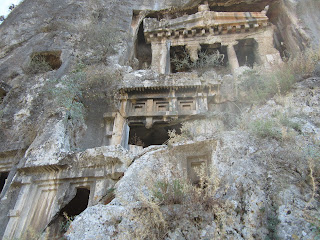 | |
| I totally climbed up to all of these like a badass archaeologist. |
 |
| Pinara - some ruins with the second acropolis in the background, riddled with tombs |
 |
| Some more rock tombs at Pınara |
 |
| View of the Pinara site from its theatre. Most of what you can see here is strewn with ruins. |
Tuesday, 27 September 2011
Fethiye
First, again no photos. I'm using a lethargic XP laptop, and it's just not worth it. I'll post pretty pictures tomorrow.
Well, this is the first time I think something has gone wrong in my favour. After dilligently getting up at 7 this morning to catch my 9 o'clock ferry to Mamaris in Turkey, I arrived at the port at about quarter past 8 to discover the ferry had already left. Apparently due to heavy sea traffic they decided last night to push it forward, calling up all the people who had booked to let them know. I had booked about 3 or 4 months ago before I had any European phone number. So, after having a quick heart attack, I asked when the next ferry was going. Apparently it was leaving at five that afternoon. However, there was another ferry heading to Fethiye at 8:30. I had originally planned to transfer via bus from Mamaris to Fethiye anyway, so this was superb. And to top it off, I could simply transfer my old ticket straight across. So, I got an earlier ferry to even closer to my destination. Win.
In Fethiye one of the first things I did was to check out the Lycian tombs. I have to admit, I have to defer to Wikipedia for almost everything about them, because it seems ancient sites in Turkey are very impoverished in informational signs. Lycia was an area in Turkey (okay, the area obviously still exists, it's just called something else now) in the southwest. It has a complicated history, and I'm still not entirely sure I understand it's full relationship with the other cultures of the time, but it seems by about the third or second century BC its culture had been largely replaced by the Greek culture. It's from this period and the following Roman period that most of the ruins come. This was immediately apparent when I saw the rock-cut tombs in the cliff above Fethiye. Obviously the Lycian culture of the time wasn't an exact carbon copy of the Greek, because I've never seen these type of tombs in Greece. The architecture of them, however, was very Hellenic. And again, like in Rhodes, there were very few tourists. Also, in addition to the lack of signage, there was also a distinct lack of things like handrails and paths. There was only one wide, concrete set of steps leading up to the biggest and main rock tomb, but the others were accessed by beating my way through scrub and clambering up steep rocks. In short, just the way I like it. In fact, I felt like Indiana Jones (helped by the presence of my Indy purse)
Back at the entrace to the site I saw a poster of an imposing theatre at a place called Pinar. I had that morning picked up my hire car for Turkey, and being on speaking terms with Karen again I plugged her in (get your mind out of the gutter) and looked up the site. It was about 50 kilometres from Fethiye, so away I went.
Driving in Turkey, by the way, hasn't been as bad as I expected. So far. It does feel very foreign, and I sense that there are some unspoken road rules I'm unaware of, but overall it's not much more chaotic than Greece.
The last two or three kilometres, while easy on traffic, almost made me wish I had hired a 4x4. Still I got there will all my hubcaps still on, and I was glad I did. Pinar was supposed to be one of the biggest city in the Lycian league (Lycia was a sort of early Federation with 23 cities). The first thing you notice when you approach the ruined city is the imposing mountain dominating the skyline, honeycombed by scores of rock-cut graves. These, however, were simple rectangular holes unlike the Ionian style tombs in Fethiye. The complex more than sated my Indiana Jones appetite - it was huge, and there was only one other German couple there. To give you an idea of its size, it has two Acropoli - one of them right on top of the mountain with the tombs I just mentioned. And all of it thickly vegetated and strewn with rocks to scramble over. It was here that I wouldn't have minded a little bit more of a setup for tourists. Hunting for paths amongst scrub to find ancient ruins is something I like, but I wouldn't mind knowing what I'm looking at when I get there. The well preserved Theatre had a sign (as if it wasn't obvious what it was), so did the Agora and the Baths, but apart from that there would have been about a dozen sites of strewn rubble around the foundations of walls that I would have liked to know what they were.
Even so, I spent three or four hours scrambling amongst the ruins, imagining I was the first to see them in two thousand years and that at any moment I would have to run away from a giant boulder. I even saw a tortoise. Not quite a snake pit or a room full of giant bugs or even a bunch of skeletons on spikes, but it was something. But after all that I didn't even get to the second Agora on top of the mountain. There were a bunch of Ionian style rock tombs I saw on the other side of the site I wanted to visit as well, but by that stage I was tired, hot, thirsty and poked to bits by spiky bushes. As much as I regretted it I had to go back to Fethiye.
Well, this is the first time I think something has gone wrong in my favour. After dilligently getting up at 7 this morning to catch my 9 o'clock ferry to Mamaris in Turkey, I arrived at the port at about quarter past 8 to discover the ferry had already left. Apparently due to heavy sea traffic they decided last night to push it forward, calling up all the people who had booked to let them know. I had booked about 3 or 4 months ago before I had any European phone number. So, after having a quick heart attack, I asked when the next ferry was going. Apparently it was leaving at five that afternoon. However, there was another ferry heading to Fethiye at 8:30. I had originally planned to transfer via bus from Mamaris to Fethiye anyway, so this was superb. And to top it off, I could simply transfer my old ticket straight across. So, I got an earlier ferry to even closer to my destination. Win.
In Fethiye one of the first things I did was to check out the Lycian tombs. I have to admit, I have to defer to Wikipedia for almost everything about them, because it seems ancient sites in Turkey are very impoverished in informational signs. Lycia was an area in Turkey (okay, the area obviously still exists, it's just called something else now) in the southwest. It has a complicated history, and I'm still not entirely sure I understand it's full relationship with the other cultures of the time, but it seems by about the third or second century BC its culture had been largely replaced by the Greek culture. It's from this period and the following Roman period that most of the ruins come. This was immediately apparent when I saw the rock-cut tombs in the cliff above Fethiye. Obviously the Lycian culture of the time wasn't an exact carbon copy of the Greek, because I've never seen these type of tombs in Greece. The architecture of them, however, was very Hellenic. And again, like in Rhodes, there were very few tourists. Also, in addition to the lack of signage, there was also a distinct lack of things like handrails and paths. There was only one wide, concrete set of steps leading up to the biggest and main rock tomb, but the others were accessed by beating my way through scrub and clambering up steep rocks. In short, just the way I like it. In fact, I felt like Indiana Jones (helped by the presence of my Indy purse)
Back at the entrace to the site I saw a poster of an imposing theatre at a place called Pinar. I had that morning picked up my hire car for Turkey, and being on speaking terms with Karen again I plugged her in (get your mind out of the gutter) and looked up the site. It was about 50 kilometres from Fethiye, so away I went.
Driving in Turkey, by the way, hasn't been as bad as I expected. So far. It does feel very foreign, and I sense that there are some unspoken road rules I'm unaware of, but overall it's not much more chaotic than Greece.
The last two or three kilometres, while easy on traffic, almost made me wish I had hired a 4x4. Still I got there will all my hubcaps still on, and I was glad I did. Pinar was supposed to be one of the biggest city in the Lycian league (Lycia was a sort of early Federation with 23 cities). The first thing you notice when you approach the ruined city is the imposing mountain dominating the skyline, honeycombed by scores of rock-cut graves. These, however, were simple rectangular holes unlike the Ionian style tombs in Fethiye. The complex more than sated my Indiana Jones appetite - it was huge, and there was only one other German couple there. To give you an idea of its size, it has two Acropoli - one of them right on top of the mountain with the tombs I just mentioned. And all of it thickly vegetated and strewn with rocks to scramble over. It was here that I wouldn't have minded a little bit more of a setup for tourists. Hunting for paths amongst scrub to find ancient ruins is something I like, but I wouldn't mind knowing what I'm looking at when I get there. The well preserved Theatre had a sign (as if it wasn't obvious what it was), so did the Agora and the Baths, but apart from that there would have been about a dozen sites of strewn rubble around the foundations of walls that I would have liked to know what they were.
Even so, I spent three or four hours scrambling amongst the ruins, imagining I was the first to see them in two thousand years and that at any moment I would have to run away from a giant boulder. I even saw a tortoise. Not quite a snake pit or a room full of giant bugs or even a bunch of skeletons on spikes, but it was something. But after all that I didn't even get to the second Agora on top of the mountain. There were a bunch of Ionian style rock tombs I saw on the other side of the site I wanted to visit as well, but by that stage I was tired, hot, thirsty and poked to bits by spiky bushes. As much as I regretted it I had to go back to Fethiye.
Subscribe to:
Posts (Atom)